Why clay causes driveway problems
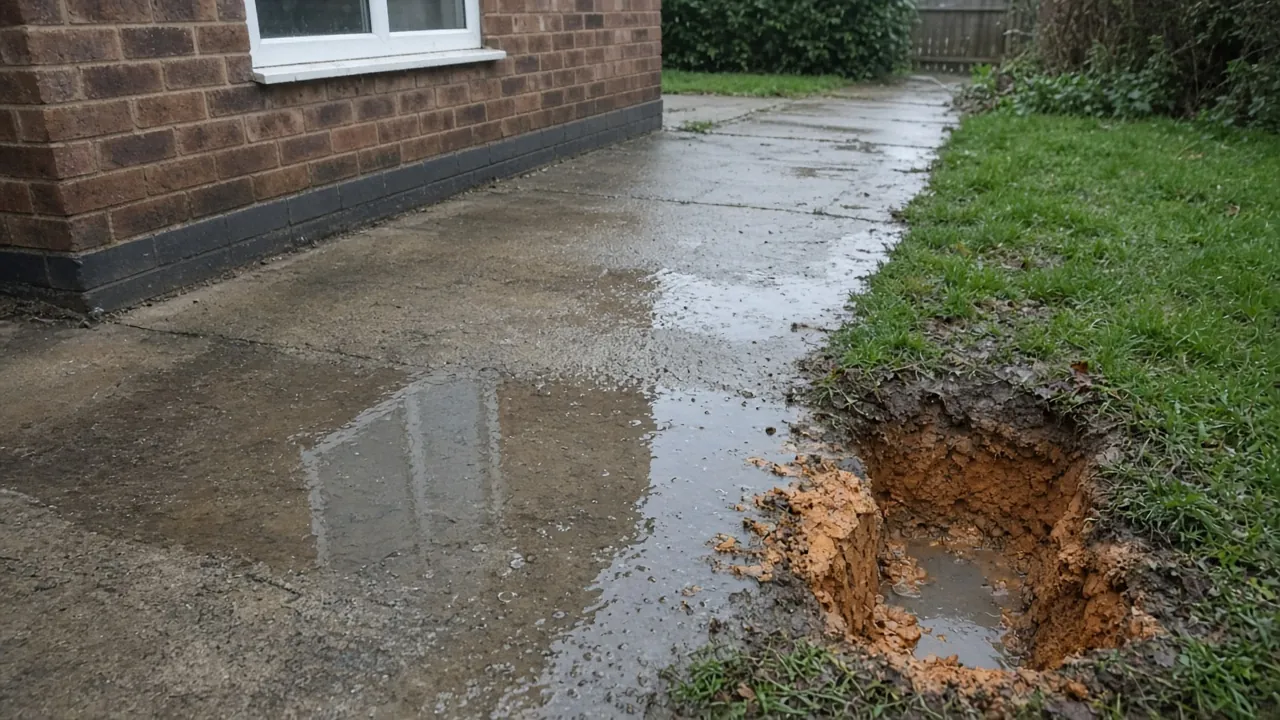
Much of the land around Middlesbrough is heavy clay left behind by glaciers. Clay is made of very fine particles packed closely together, so water moves through it slowly. In wet spells, the ground near the surface becomes saturated and has nowhere to send the water. In dry spells, clay shrinks and can crack. That combination is behind most drainage trouble on local driveways.
Water that cannot soak away. When a lawn becomes a driveway, rain that used to soak into the grass now runs off the surface. On free-draining sandy ground, a small gravel margin might absorb it. On clay, the water collects at the lowest point, which is often the garage door, the front step or the boundary with the pavement.
Weak bases. Water sitting in the sub-base or sand bed softens it. Traffic then pushes the surface down, creating ruts and dips that hold more water. Block paving sinks in the wheel tracks; tarmac cracks; resin over a wet base can fail.
Frost. Water trapped in or under a drive expands when it freezes, lifting and loosening the surface. Teesside winters are not extreme, but repeated freeze-thaw cycles on a waterlogged drive add up.
Movement. Clay that swells when wet and shrinks when dry can move a rigid surface over time, especially near trees, which draw moisture from the ground.
Signs your drive has a drainage problem:
- Puddles that are still there hours after rain stops.
- Water running towards the house, the garage or a neighbour's property.
- Green algae or moss in a strip where water flows.
- Sunken areas or rocking blocks.
- Ice forming in the same place every cold morning.
The good news is that all of these can be designed out. The key is to plan the drainage before the surface, not after.
Your drainage options
There are four main approaches, often used together.
1. Permeable surfaces. Resin bound, gravel and permeable block paving let rain soak through the surface into an open-graded, free-draining sub-base, which stores the water and lets it soak into the ground slowly. On clay, the sub-base often needs to be deeper to hold water while the clay absorbs it, and some designs include a perforated pipe to carry overflow to a soakaway or a suitable outfall. See resin driveways, gravel driveways and block paving.
2. Falls to a lawn, border or rain garden. A solid surface such as tarmac or standard block paving can be laid with a gentle fall towards a planted area on your own land. A rain garden is a shallow, planted dip designed to hold water and let it soak in. It works well for small drives and is cheap, but on clay it needs enough area to cope with heavy rain.
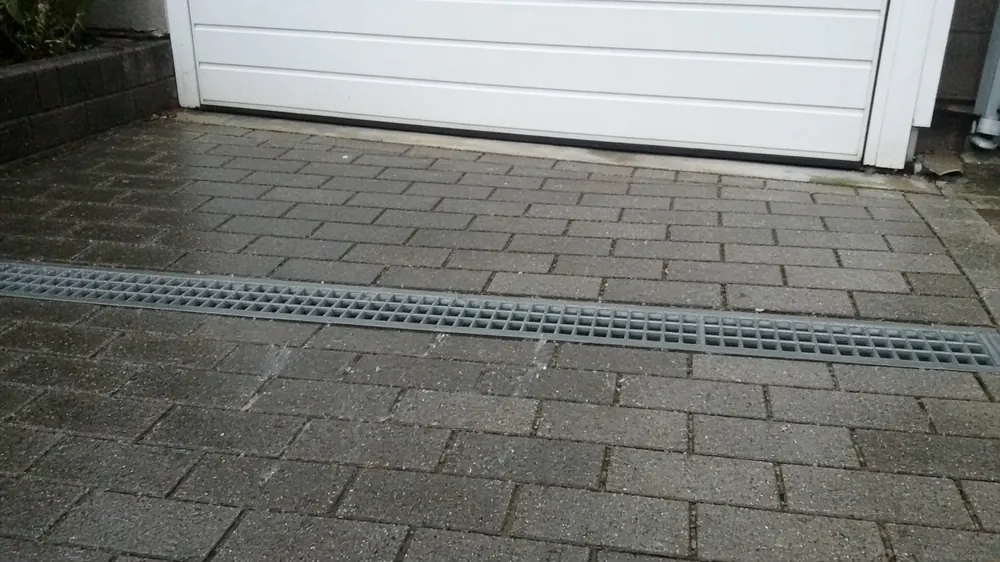
3. Channel drains. A linear drain set across the drive, often in front of a garage or at the boundary, collects water and carries it to a soakaway or another permitted outlet. Channel drains are essential where a drive falls towards a building.
4. Soakaways. An underground pit filled with crates or rubble, wrapped in geotextile, that stores water and lets it soak into the surrounding ground. On clay, soakaways need careful design (see below).
What not to do. Do not connect driveway water to the foul sewer, the pipe that carries toilet and kitchen waste. Do not let water run onto the public pavement or road from a front garden of more than five square metres of impermeable surface, as that needs planning permission. Connecting to a public surface water sewer needs the sewerage company's permission; on Teesside that is Northumbrian Water.
The government's guidance on the permeable surfacing of front gardens explains these options, with diagrams. See GOV.UK: permeable surfacing of front gardens.
Soakaways on clay: making them work
A soakaway that would work on sand can fail completely on clay. It fills up in the first heavy rain and stays full, sometimes backing water up into the drive. Getting it right comes down to a few principles.
Test the ground first. The standard method is a percolation test, set out in BRE Digest 365, Soakaway design. A hole is dug to the depth of the proposed soakaway, filled with water and timed as it drains, usually several times. The results show how fast the ground absorbs water and how big the soakaway needs to be. On heavy clay, the answer can be "very big" or "not suitable".
Size it for the area and the ground. The soakaway has to store the water from a heavy storm falling on the drive and then empty within a reasonable time. Slow-draining clay means more storage. Modern plastic crates hold far more water per cubic metre than rubble, which helps on tight plots.
Keep it away from buildings. Building Regulations guidance in Approved Document H says soakaways should not be built within 5m of a building or road, or in areas of unstable land. Water soaking into clay next to foundations can cause movement.
Wrap it. A geotextile membrane around the soakaway stops fine clay particles washing in and clogging it.
Allow for overflow. Where the ground is very slow, a soakaway may need a high-level overflow to a permitted outlet, or the design may need to rely more on permeable surfaces and rain gardens.
Follow the drainage hierarchy. Approved Document H sets an order of preference for rainwater: first an adequate soakaway or other infiltration system, then a watercourse, and only then a sewer. On clay you may find infiltration alone is not enough, and you may need to discuss alternatives with the council or Northumbrian Water.
A good installer will either carry out a percolation test or explain why the design does not depend on one, for example where the drive drains to a large lawn.
Planning the drainage before the surface
The drainage should be designed at the survey, not added once the surface is down. Things to ask about:
- Where does water go now? Watch your front garden in heavy rain before the survey. Where does it pool? Where does it run?
- What are the levels? The drive should fall away from the house, be at least 150mm below the damp-proof course and not cover air bricks.
- Which surface suits your ground? A permeable surface reduces runoff but still needs a base and ground that can take the water.
- Is a soakaway needed, and how big? Ask whether a percolation test will be done.
- What happens in a storm? Ask where the overflow goes if the soakaway or base fills.
- Are there trees nearby? Roots affect drainage and soakaway placement.
Getting this right adds some cost, but it is much cheaper than relaying a sunken drive in a few years. Our driveway cost guide shows how drainage fits into an overall budget, and our planning guide explains the front-garden drainage rule.
Area pages with clay and drainage notes for your street: Nunthorpe, Marton, Thornaby and Stokesley.
Questions people ask
Why does my driveway flood when it rains?
Usually because the ground underneath is clay that drains slowly, and the drive has no permeable surface, adequate falls, channel drain or properly sized soakaway to deal with the water.
Do soakaways work in clay soil?
They can, but they must be sized from a percolation test and are often much larger than on sandy ground. On very heavy clay a soakaway alone may not be enough.
How far should a soakaway be from my house?
Building Regulations guidance in Approved Document H says soakaways should not be within 5m of a building or road, or in areas of unstable land.
Is a permeable driveway enough on clay?
Often, if the sub-base is deep enough to store water while the clay absorbs it. In very slow ground, an overflow to a soakaway or other permitted outlet may be needed.
Can I connect my driveway drain to the sewer?
Never to the foul sewer. Connecting to a public surface water sewer needs the sewerage company's permission; on Teesside that is Northumbrian Water.
What is a percolation test?
A test, set out in BRE Digest 365, where a hole is filled with water and timed as it drains. It shows how quickly the ground absorbs water and how large a soakaway needs to be.